How does a human learn to sing?
The question seems simple.
How does a person learn to sing?
Do they start by composing their own songs from scratch?
Do they learn to stay in tune while writing their first lyrics?
Or do they first learn by singing other people’s songs?
If we are honest, the answer is not that mysterious.
Almost nobody begins music from a blank page. Almost nobody discovers their voice in total silence. Almost nobody becomes a singer without first spending years listening, imitating, repeating, and feeling songs they did not write.
First, we listen.
Then, we hum.
Then, we sing along.
And only much later do some people begin to create something of their own.
Before creating music, we all imitate music
Everyone who loves music has gone through something like this.
There was a song that touched a nerve. A voice that went straight through us. A chorus that stayed in our head for days. A melody that, without asking permission, made us sing.
That is usually the first real contact with music: not theory, not technique, not composition. Emotion.
We grew up listening to The Rolling Stones, The Beatles, Queen, Guns N’ Roses, and so many others. Other people grew up with jazz, flamenco, soul, boleros, rancheras, rock, pop, hip hop, or electronic music. The genre does not matter. The mechanism is the same.
You hear something.
It hits you.
You repeat it.
You internalize it.
And without realizing it, it starts shaping the way you understand music.
99% of people who love music have done this. They have sung other people’s songs at home, in the car, in the shower, in a bar, on a small stage, or alone.
Later, a minority discover that they have a voice, an ear, a sensitivity, or something to say. Then a different path begins: writing, recording, producing, making mistakes, and eventually finding an identity.
But the beginning is almost always the same.
Music enters before it comes out.
What comes first: the singer or the songwriter?
When it comes to singer-songwriters, the question becomes more interesting.
What comes first?
The singer or the lyricist?
The voice or the writing?
The interpretation or the composition?
The answer is not always the same, but one thing is fairly clear: even people who write their own songs were almost always listeners first.
A songwriter does not write from a vacuum. They write from an emotional archive built over years: songs they have heard, lines they remember, voices they admire, structures they have absorbed, melodies that stayed with them.
That does not mean copying.
It means learning a language.
Nobody accuses a guitarist of stealing because they learned by playing other people’s riffs. Nobody calls a singer a pirate because they started out performing songs they admired. Nobody is scandalized when a songwriter openly acknowledges their influences.
In fact, we usually celebrate it.
We say they have musical culture.
We say they have references.
We say they know the tradition.
We say they grew up on great music.
When a human imitates, it is seen as a natural part of artistic learning.
So why does everything change when we talk about artificial intelligence?
This is where the storm begins.
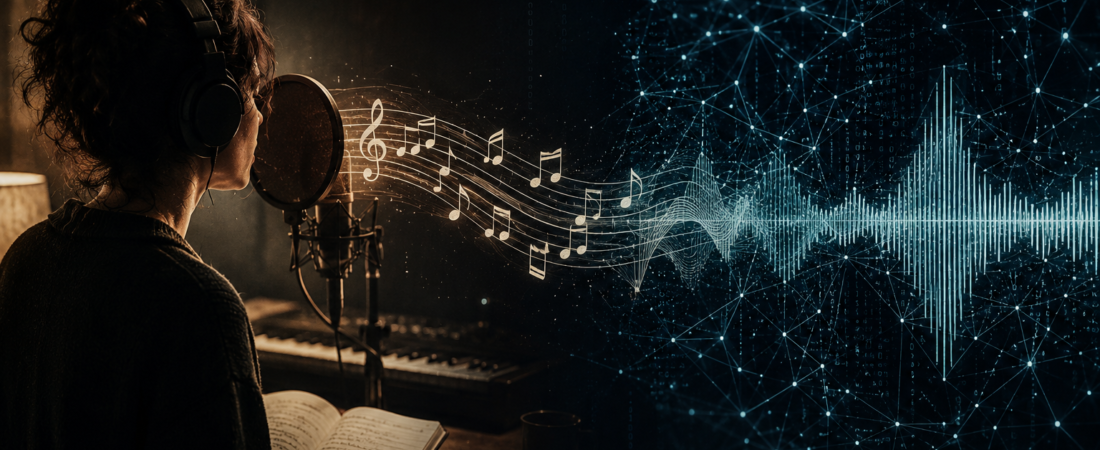
AI-generated music is at the center of the debate for precisely this reason: AI models learn to create music by analyzing music that already exists.
They observe patterns.
They detect structures.
They learn relationships between rhythm, harmony, melody, timbre, style, emotion, and production.
And from that learning, they generate new pieces.
Put that way, the process does not seem completely alien to what humans do. Of course, it is not identical. AI does not have a childhood, memories, a body, a mother singing in the kitchen, or one particular night forever tied to a song.
But there is an uncomfortable similarity: both humans and AI learn to create music from music that already existed.
And that is where the double standard appears.
When a person does it, we call it influence.
When AI does it, we call it a threat.
The ethical problem of AI music is not as simple as it seems
The discussion is often presented in a very clean way:
“AI has learned from human music without permission.”
Fine.
It is a powerful sentence. It sounds fair. And it points to a legitimate concern: the rights of artists, songwriters, producers, and all the professionals who have built the musical heritage from which technology now learns.
That debate is real, and it should not be dismissed.
But it should not be oversimplified either.
Because then the inevitable question becomes this:
Where exactly do we draw the line between learning, inspiration, training, copying, and exploitation?
When a person spends years listening to copyrighted songs, learning from them, absorbing resources, imitating phrasing, copying structures, studying arrangements, and building their style on all that previous material, are they also using other people’s work to create a career of their own?
Yes.
The difference is that we have always accepted that as a natural part of culture.
A musician is not born in isolation. They are born into a huge conversation that began before them. Every artist arrives carrying influences, obsessions, references, and invisible debts.
Music has always moved forward like this.
Through memory.
Through repetition.
Through transformation.
Through mixture.
Through inheritance.
Does AI music copy or learn?
This is the question that really matters.
If AI reproduces a specific song, imitates a protected voice, or generates something deliberately confusingly similar to an existing work, then yes, there is an obvious problem.
That should not be defended.
That is not creativity. That is substitution in disguise.
But if AI learns general patterns from thousands or millions of songs and generates a new work, the discussion changes. We are no longer necessarily talking about direct copying, but about statistical learning, technical influence, and new outputs generated from previous patterns.
Does that remove every dilemma?
No.
But it does force a more serious conversation.
Because if all learning based on previous works were automatically suspicious, then we would also have to reconsider how human musicians, producers, arrangers, DJs, filmmakers, writers, and virtually every creator learn within an existing culture.
Creativity never appears in a clean laboratory.
It appears contaminated by references.
The real fear is not that AI learns
People often say that the big problem is that AI has learned from human music.
But perhaps that is not the real fear.
Perhaps the real fear is something else: that AI can produce too much, too fast, and too cheaply.
That is a much deeper problem.
Because one thing is using artificial intelligence as a creative tool, with artistic direction, human judgment, selection, rejection, editing, intention, and responsibility.
And something very different is turning music into an endless factory of generic songs designed to occupy space.
That is where an important part of the conflict lies.
Not in the fact that AI learns.
But in what it is used for.
It is not the same to use AI to explore a musical idea as it is to release thousands of soulless tracks to flood playlists.
It is not the same to direct a song as it is to spit out content.
It is not the same to create with AI as it is to hide the lack of judgment behind AI.
The tool does not solve the ethics of the creator.
It reveals them.
The question that makes the music industry uncomfortable
There is another part of this debate that also deserves a closer look.
The issue is often framed as a pure defense of artists. But in the music industry, very little is ever that pure.
When major record labels and tech companies clash over artificial intelligence, they are not just arguing about ethics. They are also arguing about control, licensing, catalogs, power, money, and market position.
That is why the uncomfortable question is this:
Does the ethical problem disappear when billion-dollar deals are signed?
If AI learns from music without an agreement, it is presented as a moral threat.
But if one giant company signs licenses with another giant company, does the exact same process suddenly become acceptable?
Are we really defending creators?
Or are we simply deciding who gets paid for training the next generation of music systems?
That is not a minor question.
Because if the debate is reduced only to permissions and payments between giants, many independent artists will once again be left outside the conversation.
As usual.
AI music needs human judgment, not a free-for-all
Defending music made with artificial intelligence does not mean defending every possible use of artificial intelligence.
It does not mean accepting blatant copies.
It does not mean justifying cloned voices without consent.
It does not mean ignoring copyright.
It does not mean saying everything is fine because “humans also learn by listening.”
That argument would be too easy. And too weak.
The real point is different.
Artificial intelligence can be a powerful creative tool if there is human direction behind it. If someone decides what they want to say. If someone filters. If someone listens. If someone rejects ninety mediocre versions until finding one that feels true. If someone builds an artistic universe instead of just a folder full of files.
That is where it begins to make sense.
AI can generate sound.
But intention still matters.
Selection still matters.
Sensitivity still matters.
Story still matters.
The difference between an empty song and one that connects is not only how it was produced. It is what was done with that production.
Learning from others is not the problem. Failing to transform it is.
Music has always been a chain of learning.
One artist listens to another.
One generation reinterprets the previous one.
A genre is born by mixing earlier genres.
A voice finds its path after singing many voices that came before.
That does not destroy music. It keeps it alive.
The problem is not learning from what came before.
The problem is failing to add anything afterward.
And that standard should apply equally to humans and machines.
If a song created with AI has no judgment, no emotion, no direction, and no identity, it will be noise, even if it sounds technically polished.
If a human-made song has nothing to say, it will also be noise, even if it was written with a guitar, a notebook, and real pain.
Authenticity does not depend only on the tool.
It depends on the result, the intention, and the honesty with which it is presented.
The right question about AI-generated music
Maybe we should stop asking only:
“Can AI make music?”
Because the answer is already obvious.
Yes, it can.
The more interesting question is this:
What kind of music do we want to make with AI?
Fast, generic, disposable music?
Or directed, curated, and carefully built music with a human vision behind it?
At Versiona Studio, we care about the second.
We do not believe artificial intelligence automatically replaces human creativity. But we do believe it forces creators to ask harder questions.
What are you bringing to the table?
What are you deciding?
What are you rejecting?
What story are you telling?
Because if AI does everything and you only press a button, you are probably not creating much.
But if you use AI as an instrument, as a studio, as a laboratory, and as an extension of an artistic vision, then the conversation changes.
A lot.
Conclusion: music has always learned from music
A human learns music by listening to music.
An AI learns music by analyzing music.
They are not identical processes, but they are not completely separate worlds either.
The important difference is not only where the learning comes from. It is how that learning is used afterward.
Copying is not creating.
Imitating without transforming is not creating.
Mass-producing content without intention is not creating.
But learning, mixing, selecting, directing, and building something new from what came before has always been central to music.
Artificial intelligence does not erase that tension.
It puts it in front of everyone.
And maybe that is exactly why it bothers so many people.
Because it forces us to look at an uncomfortable truth: no creator starts from zero.
Not even humans.